Industrial
Infrastructure & Site Development
Heavy VDF &
Stormwater Drainage
Industrial Infrastructure & External Development
We deliver comprehensive industrial infrastructure and
site external development solutions for manufacturing
complexes, aerospace parks, logistics hubs, and commercial
campuses across Karnataka. From heavy-duty Vacuum
Dewatered Concrete (VDF/Tremix) roadways and asphalt
paving to subsurface stormwater networks, security
boundary walls, high-voltage transformer yards,
underground utility corridors, and environmental rainwater
harvesting sumps, we engineer high-performance exterior
environments built to withstand demanding logistics and
weather extremes.
Our Core Industrial Infrastructure Capabilities
Heavy Industrial Roadways & Paving
Construction of high-axle-load asphalt pavements,
Vacuum Dewatered Concrete (VDF/Tremix) roads, and
heavy interlock paver aprons engineered for continuous
40-tonne container vehicle movement.
Stormwater Drainage & Rain Harvesting
Cast-in-situ RCC box culverts, graded stormwater
drainage channels, silt catchpits, dual-filtration
recharge borewells, and high-capacity underground
harvesting tanks.
Perimeter Security & Retaining Walls
Reinforced concrete compound boundary walls,
crash-rated security entrance gates, perimeter
fencing, security sentry posts, and engineered
earth-retaining gravity structures.
Underground Utility Corridors
Underground trench corridors for high-voltage power
conduits, fire hydrant ring mains, potable water
distribution networks, and sewage treatment plant
(STP) civil holding tanks.
Featured External
Infrastructure
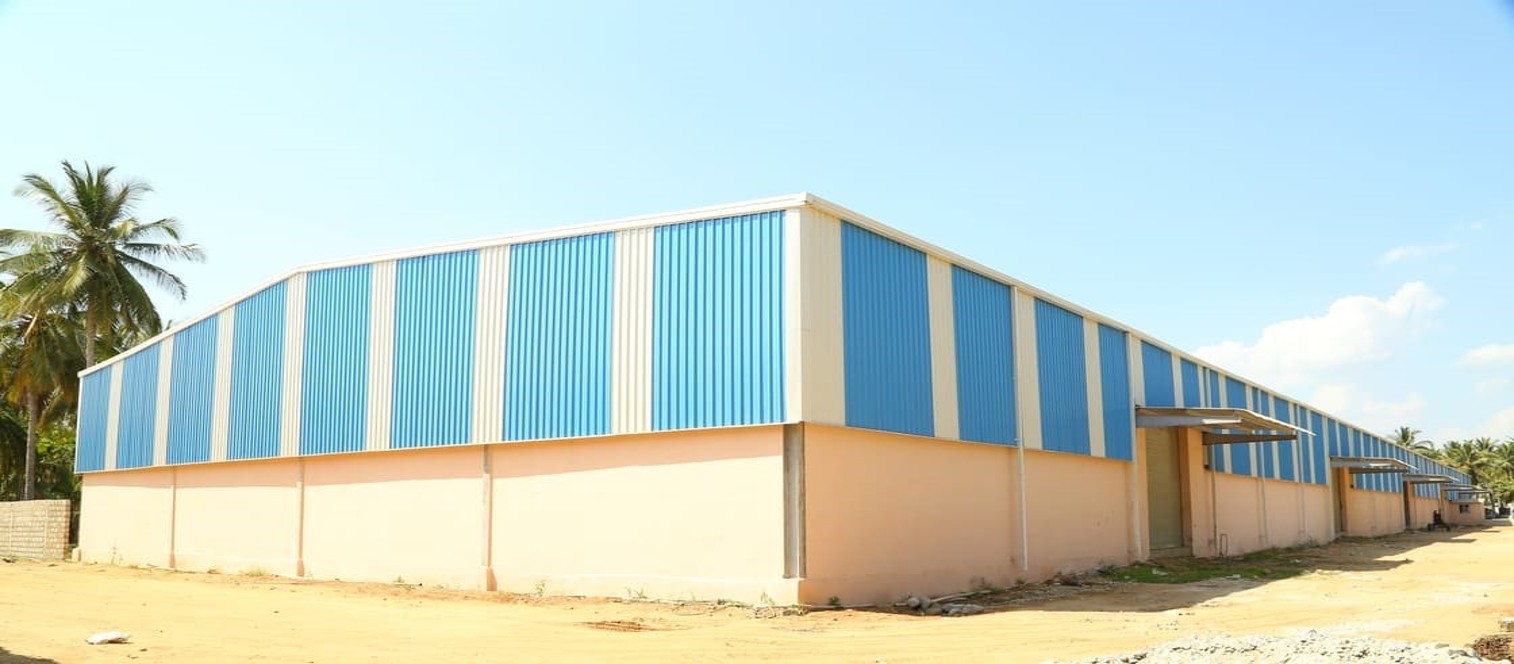
M/s LCA Pvt Ltd & Prasidh Industries — Industrial Campus
Infrastructure
Delivered comprehensive external development across
industrial campus grounds including 30-meter wide
logistics roadways, subterranean stormwater drainage
channels, security perimeter walls, and heavy vehicular
entrance gates built to handle 40-tonne container
trailers.
Our External Development Execution Process
01
Terrain Survey & Grading
Total Station topographical mapping, cut-and-fill
optimization, and stormwater runoff modeling.
02
Underground Utilities
Trench excavation, laying of storm drains, fire
hydrant ring mains, and electrical conduits.
03
Subgrade & Road Paving
Roller compaction, GSB/WMM laying, and Vacuum
Dewatered Concrete (VDF) / asphalt surfacing.
04
Perimeter & Security
Compound wall casting, heavy entrance gates, road
kerbs, street lighting, and final audit.
Frequently Asked Questions
-
What is Vacuum Dewatered Concrete (VDF/Tremix) and
why is it preferred for industrial roads?
VDF (Tremix) flooring extracts excess water from
freshly placed concrete using a high-suction
vacuum mat. This process dramatically reduces
the water-cement ratio, increasing compressive
strength by up to 25%, virtually eliminating
shrinkage cracks, and delivering a dense,
abrasion-resistant surface designed to withstand
continuous heavy forklift and container truck
traffic.
-
How do you prevent waterlogging and flooding in
large campus sites?
We perform hydrological calculations based on
50-year peak rainfall data to size RCC storm
drains with adequate slope velocity (minimum
1:150). Silt traps, interceptor chambers, and
deep percolation recharge pits are integrated to
quickly convey runoff into harvesting reservoirs
without surface ponding.
-
Can site infrastructure work proceed in parallel
with main building construction?
Yes. We phase external development
strategically. We first establish site boundary
security, perimeter drainage, and stabilized WMM
access tracks to keep logistics moving during
civil construction. Final finishing—including
asphalt top layers, paver blocks, and
landscaping—is completed during facility
commissioning.
-
What statutory rainwater harvesting systems do you
install?
We construct dual-action systems adhering to
BWSSB and state pollution board norms. These
include large-capacity underground reinforced
concrete storage sumps for reuse in campus
flushing and landscaping, paired with deep
gravel-packed recharge borewells that replenish
the local groundwater aquifer.